Should You Repair or Replace Your York Roof?
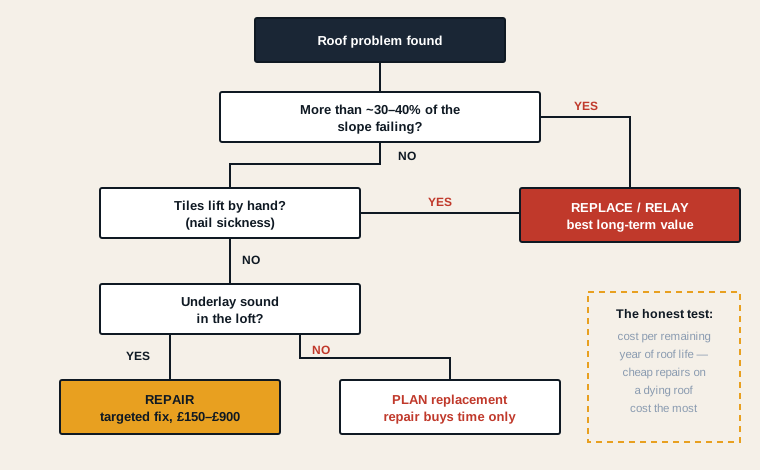
The Three Tests
Test 1 — Extent of failure. If less than a third of the roof slope is affected, repair is almost always the right call. If more than a third has failed — tiles cracked, slipped, or missing across a wide area — the cost of repairing tile-by-tile quickly exceeds the cost of stripping and re-tiling the whole slope. The breakeven is typically around 30-40 percent.
Test 2 — Fixing condition. Lift a tile. Does it come away easily? Can you see rust dust on the membrane below? If the nail crumbles when you touch it, you have nail sickness — and it's systemic, not localised. In York, this affects virtually every 1960s-80s property in Huntington, Rawcliffe, Chapelfields, and Foxwood. Repairing individual tiles when the fixings are corroding everywhere is money wasted — they'll slip again in the next storm. Replacement with stainless steel fixings is the permanent solution.
Test 3 — Underlay condition. In the loft, check the membrane between the battens. Is it intact and dry, or is it torn, sagging, or wet? Sound underlay means a repair on the outer covering is sufficient. Degraded underlay means water is reaching the timbers even when the tiles are in place — the secondary defence has failed and the whole covering needs replacing.
The Cost-Per-Year Test
This is the honest calculation that cuts through the repair-vs-replace debate. If your roof has 10 years of life left and you're spending £400/year on repairs, that's £4,000 over the remaining life — then you still need to replace it. A replacement now at £6,500 gives you 40+ years of zero-maintenance life at £162/year. The repair path costs more per year of service and leaves you with a deteriorating asset throughout.
What We See Across York
1930s stock (Dringhouses, Tang Hall, Acomb): Clay tiles now 85-90 years old. Individual tile replacement is still viable where damage is localised, but widespread cracking and delamination means many of these roofs will need replacing within the next decade. If more than 1 in 5 tiles shows frost damage, plan for replacement.
1960s-80s stock (Huntington, Rawcliffe, Chapelfields, Foxwood): Concrete tiles with nail sickness. Once detected, replacement is almost always the right call — the fixings are failing systemically and individual repairs are temporary. A re-roof with stainless fixings costs £5,500-£7,500 for a typical semi.
Victorian stock (South Bank, Heworth, Clifton): Welsh slate lasts 100+ years but individual slates delaminate. If fewer than 20-30 percent are affected, a strip-and-relay (removing all slates, replacing failed ones, refixing the rest with copper nails) saves the roof for another 50+ years at 60-70 percent of full replacement cost.
What We'll Tell You
We have no financial incentive to push replacement over repair. A £300 repair generates a satisfied customer who calls us again and refers neighbours. A £7,000 replacement pushed when repair would have done the job generates a customer who feels oversold. Our reputation in York depends on giving honest advice — and we've been trading here since 2005 because we do exactly that. Call 0190 459 3302 for a free survey and we'll give you the data to decide for yourself.